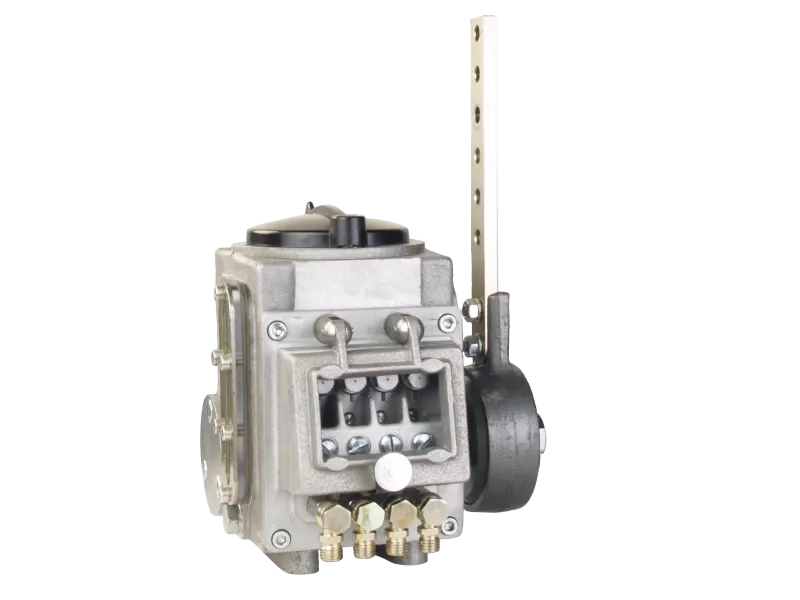
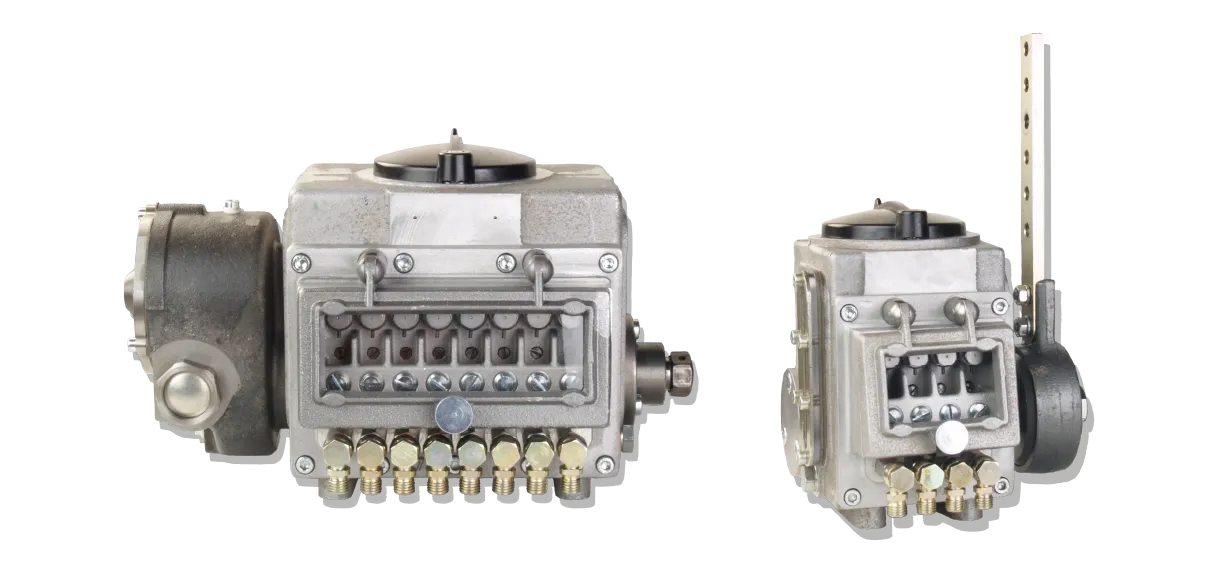
with gear drive and oscillating drive.
Standard-Oiler Model Delimon
for up to 20 Lubrication points
Standard version:
- Modes of driving: direct drive rotating or oscillating or electrical motor
- For oil and emulsion
- Drop sight control
- For minimum quantity lubrication of up to 20 points of lubrication
- Delivery rate of 0,25cm3 per stroke on each lubrication point.
- Admissible operating pressure max. 150 bar depending on the number of connections
Special version
- with monitoring unit
- with manuel pre lubrication
- with heating facility
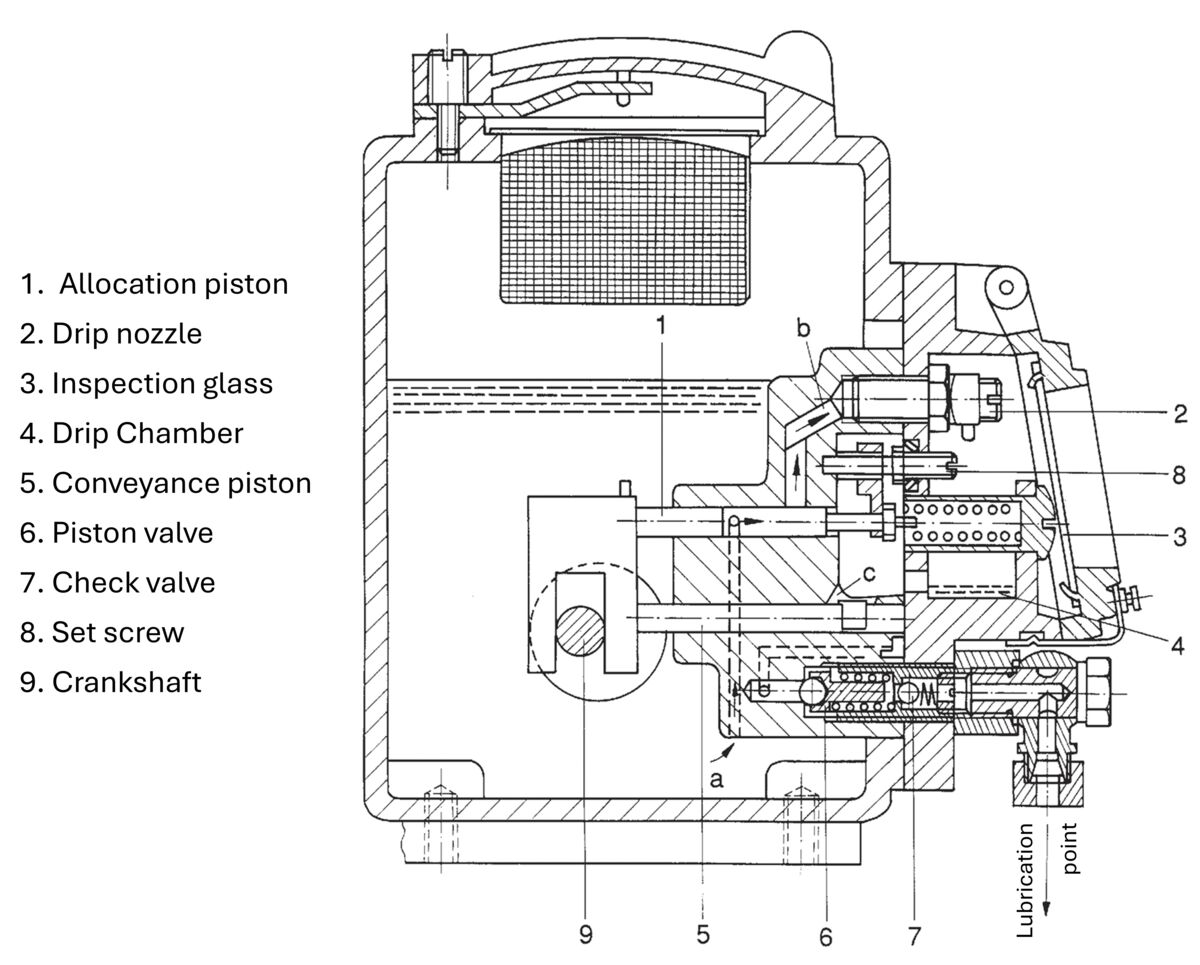
The oil lubrication pumps are positively controlled piston pumps, whose pump body serves as an oil reservoir. A separate allocation piston is available for each point of lubrication. The discharge volumes can be individually adjusted for each point of lubrication. The function can be monitored via a drop indicator with inspection glass. The oil lubrication pumps are designed for central lubrication systems with up to 20 points of lubrication, whereas a maximum of two different kinds of oil can be conveyed with one pump. A multitude of combination possibilities regarding casing arrangement, driving mode and diverse auxiliary facilities offer a suitable solution for all requirements.
The crankshaft (9) moves the allocation piston (1) and the conveyance piston (5). The allocation piston (1) thereby sucks the lubricating oil through the channel (a) out of the crank case and conveys it through the channel (b) to the drip nozzle (2). From there it drops, visible through the inspection glass (3), into the drip chamber (4). The conveyance piston (5) sucks the lubricating oil out of the drip chamber via the channel (c) and conveys it to the point of lubrication via the spring-loaded piston valve (6) and the check valve (7). Each pump element conveys 0 ... 0,25cm3 per stroke of the piston,depending on the setting. The discharge volume is adjusted via the set screw (8), whereby turning in the minus-arrow direction determines a lesser discharge volume and turning in the plus-arrow direction determines a larger discharge volume. Is the volume of a pump element to be adjusted to min. or max., then the set screw must be turned in the respective direction until resistance is noticeable. One subsequently turns the set screw (8) back half a turn.
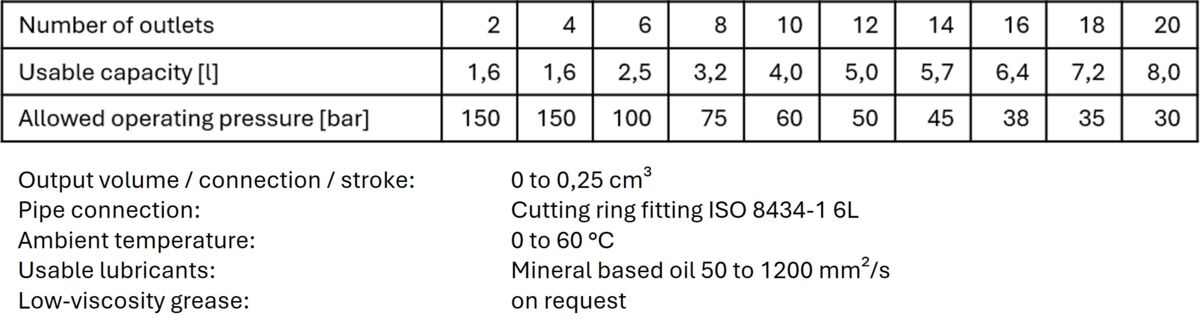
These standard oil-lubrication pumps—comprising a drive mechanism, housings, and associated internal components—are available with 2 to 20 outlets. They are designed to handle either a single type of oil or two different types simultaneously. Depending on the drive mechanism, the pumps can achieve between 5 and 17 piston strokes per minute. A hand crank attached to the shaft stub allows for manual pre-lubrication.
There are two drive variants available for the Delimon lubricator: The rotary drive can be configured with a drive shaft to the left, to the right, or to the front and rear.